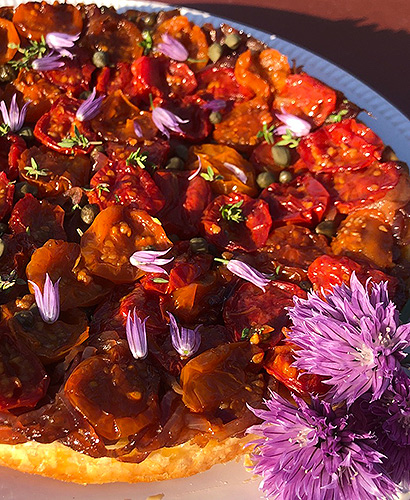
Roasted Tomato & Caper Tart (Serves 2 - 4)
If you can find yellow and red tomatoes the tart will look especially good. Slowly baking the tomatoes first will really intensify their flavour and is well worth the extra step.
500g small tomatoes, halved
salt and black pepper
olive oil
2 red onions, finely sliced
1 tbsp balsamic vinegar
1 tsp soft brown sugar
1 tsp fresh thyme leaves
1 tbsp butter, for greasing
1 x 240g pack of ready-rolled puff pastry
2 tsps small capers, drained
Chive flowers, to finish (optional)
Heat the oven to 120ºC / 100ºC fan / Gas ½. Lay the tomatoes cut-side up on a lightly oiled baking tray. Season with salt and pepper and drizzle with a little olive oil. Roast them for 3 - 4 hours, depending on the size of the tomatoes - small ones won’t take as long, so remove them first.
Heat a tablespoon of oil over medium heat and add the sliced onions. Fry gently for 10 minutes or so until they are soft, then add the vinegar, sugar, thyme and a little seasoning. Continue cooking until the onions are soft and sticky.
Generously butter a 20 - 24cm shallow cake pan. Lay the tomatoes cut-side down in the pan, squeezing them all in. Scatter over the capers followed by the cooked onions.
Cut a circle of pastry slightly larger than your pan and gently lay the pastry over the tomatoes and onions, loosely tucking in the sides of the pastry. When ready to cook, heat the oven to 220ºC / 200ºC fan / Gas 7 and bake for 20-25 minutes or until gold brown and crisp. Allow the tart to cool for about 5 minutes, then run a knife around the edges and carefully turn out onto a serving plate. Scatter some chive flowers over the top (optional) and serve at room temperature.
Asparagus, Pea and Mint Tart (Serves 4 - 6)
320g ready-rolled puff pastry
300g asparagus
100g petit pois peas, blanched and drained
300ml double cream
2 small eggs, beaten
¼ tsp grated nutmeg
2 tsps dried mint or 2 tbsps fresh mint, finely chopped
black pepper
100g gruyere cheese, finely grated
Line a 22cm loose-based, fluted flan tin with the pastry, trim the edges and set aside. Snap off the woody stems of the asparagus and discard, then lightly steam the asparagus for no longer than four minutes - less if they are thin spears. Lay on some kitchen towel to drain and allow to cool.
Heat the oven to 200ºC / 180ºC Fan / Gas 6. Prepare the filling by cutting off the first few inches of each asparagus spear and reserving these tips for later. Place the remaining asparagus in a food processor together with the peas, cream, eggs, nutmeg, mint and black pepper. Blitz in the processor for a minute or until the vegetables are all very finely chopped. Add the cheese and blitz again for a moment.
Pour the filling into the pastry case and arrange the reserved asparagus tips on top. Place in the hot oven and bake for 20 - 25 minutes or until the pastry is crisp and the tart is nicely risen and brown. Reduce the temperature of the oven to 170º / 150ºC Fan / Gas 3 and cook for a further 10 minutes. Allow to cool slightly before serving or serve at room temperature.
Raspberry, Orange & Cardamom Fool (Serves 6 - 8)
I am still using last summer’s raspberries from the freezer and they work really well in this recipe. Of course you can use freshly picked raspberries and, if I’m honest, I think they have the edge on flavour - still holding some of that summer sunshine.
400g fresh or frozen raspberries
grated zest of 1 orange
seeds from 5 cardamom pods, crushed
300ml double cream
2 - 3 tbsps icing sugar (depending on the sweetness of the fruit)
500ml Greek yogurt
To serve: fresh raspberries and raspberry jam
Set aside 6 - 8 small dessert glasses or bowls. If using fresh raspberries, reserve a few for using on top of the finished fools.
Using a food processor, blitz the raspberries with the orange zest and crushed cardamom seeds until smooth. Whisk the cream and icing sugar together until soft peaks form, then gently fold in the yogurt - in two or three goes. Follow with the raspberry mixture, gently filling it in half at a time to keep as much air in the mixture as possible.
Divide the mixture between the glasses or bowls and refrigerate for at least 2 hours. Top with a swirl of raspberry jam and a few fresh raspberries.
Sweet and Spicy Asian-Style Pickled Carrots
This sweet and sour pickle will keep in the fridge for 2 - 3 months. It is great served with barbecued and slow-cooked meats, cheese or transformed into a piquant salad with fresh coriander, sesame seeds and a handful of crushed peanuts.
1kg carrots, peeled
400ml cider or rice vinegar
300ml water
250g granulated sugar
1 heaped tsp. sea salt
1 tsp dried peperoncino chillies, or chilli flakes
4 whole star anise
100g fresh ginger root, peeled and very thinly sliced
1 large clove garlic, peeled and very thinly slice
Prepare a large Kilner-style jar (or two smaller jam jars with lids) making sure that everything is clean and warm.
Cut the carrots into very fine julienne strips using a mandolin, if you have one. Alternately, use a vegetable peeler to peel long thin strips or coarsely grate the carrots.
Combine the vinegar, water, sugar, salt, spices, ginger and garlic in a large saucepan and heat gently until the sugar has dissolved. Bring to the boil and and add the prepared carrot. Bring back to the boil and cook for 2 minutes. Remove from the heat.
Using tongs, carefully transfer the carrots to the warm jar/s and pack down firmly to remove any air pockets. Pour over the remaining pickling juice and seal the jar.
Carrot Cake with Rosemary & Orange
This is a single layer cake that can double as a dessert when served with whipped cream, Greek yogurt or mascarpone, but it is also excellent with a cup of coffee. You don’t need a strong-flavoured oil for this cake so it is best to use a basic olive oil rather than a super-special one. This cake stays moist for several days and what’s more, it is gluten and dairy-free.
250g carrots, peeled and grated
150g caster sugar
3 eggs, beaten
125ml olive oil
1 tsp vanilla extract
250g ground almonds
1 orange, zested
1-2 tbsps orange juice
3 tsps of finely chopped rosemary leaves, plus a few extra rosemary leaves, to finish
3 tbsps pine nuts or flaked almond, lightly toasted
Preheat the oven to 180°C / Fan 160°C / Gas 4. Grease the base and sides of a 23cm / 9 inch spring-sided cake tin and line with baking parchment (or use one of those wonderful pre-formed cake tin liners from Lakeland).
Whisk the sugar and eggs until creamy and light then, whilst still whisking, drizzle in the oil until it is all incorporated. Add the vanilla extract, then gently fold in the ground almonds, together with the grated carrots, orange zest, a little orange juice to mix and the finely chopped rosemary.
Pour the mixture into the prepared tin and level it with the back of a spoon. Sprinkle over the lightly toasted pine nuts, or almonds and a few whole rosemary leaves. Bake for 35 - 40 minutes or until the top is light golden brown and a skewer inserted into the centre of the cake comes out clean. Allow the cake to cool for a few minutes before removing the baking parchment.
Roasted vegetable ratatouille
Roasting the vegetables before making ratatouille makes this a richer, more flavourful dish and, by deliciously caramelising the vegetables they lose some of their moisture and stay chunky when made into ratatouille. Ratatouille is perfect for freezing and is a quick and easy way to preserve some summer vegetables for use throughout the year.
3-4 courgettes,
3 peppers (red, yellow and orange)
2 red onions, peeled
3-4 garlic cloves
Olive oil
Salt and freshly ground black pepper
250g tomatoes
1 x 400g can chopped tomatoes
2 tblsps concentrated tomato purée, or
'Bomba' - a tomato purée seasoned with vegetables, herbs and spices
a pinch of chilli flakes, optional
A handful of fresh basil
Preheat the oven to 200°C / Fan 180° / Gas 6. Remove the soft, seedy, inner core of the courgettes if they are large and remove the seeds from the peppers. Chop all the vegetables into chunks so that they are roughly the same size. Peel 3-4 cloves of garlic and cut each clove in half. Put all this into a large roasting pan, making sure that the vegetables have plenty of space - if necessary, use two pans. Drizzle over 3-4 tablespoons of olive oil and season with salt and pepper.
Roast for 35-40 minutes, turning the vegetables after 20 minutes. Remove from the oven and toss in the cherry tomatoes or quartered larger tomatoes, followed by the chopped tinned tomatoes, tomato purée and the chilli flakes, if using. Return the pan to the oven and continue cooking for a further 10 minutes, or until the cherry tomatoes have burst open. Check the seasoning, adding more salt and pepper to taste, and scatter over the torn basil.
Roasted raspberry jam
I recently came across this recipe and it is SO easy and quick to make that I thought I would pass it on. If you haven’t made jam this way before, it basically takes 30 minutes from start to finish and roasting the fruit seems to really intensify the flavour.
- 1kg fresh or frozen raspberries
- 900g caster sugar
- Juice of one large lemon
Preheat the oven to 200°C / Gas 6. If using fresh raspberries they must be dry, so do not wash them. Place the raspberries in a large metal roasting pan and roast for 30 minutes. After 20 minutes, pour the caster sugar into a small roasting pan and heat in the oven for the last 10 minutes of the overall cooking time. Remove both pans from the oven and tip the hot sugar into the roasted fruit. Stir in the lemon juice then place the pan on the hob and stir for a minute or two, until the sugar is completely dissolved. Instant jam! Pour into warmed, clean jars and seal.
Shoestring Courgette Fritti
3-4 medium sized, firm courgettes
Approx. 500ml vegetable oil, for frying
250ml milk
100g plain flour
Sea salt and freshly ground black pepper
Lemon wedges, to serve
Discard the ends of the courgettes and slice each courgette in half lengthways. If the centres of the courgettes are a bit soft and seedy, scoop this out using a teaspoon and discard, then cut the firm flesh in long, thin strips, about 0.5cm x 0.5cm. If you have a mandolin you could use this - but mind your fingers!
Pour the milk into a small, shallow dish, wide enough to accommodate the courgette strips. Place the flour in a similar dish and season with salt and pepper. Prepare a baking tray lined with paper towel. Heat the oil* in a large saucepan (it should come about one third of the way up the side of the pan) or in a deep-fat fryer.
Take a handful of the courgette strips and dip them in the milk. Shake off the excess liquid then dust the strips in the flour, giving them a little shake to remove any loose flour. Using a slotted spoon, gently drop them into the hot oil and use the spoon to separate the strips. Fry for 2-3 minutes or until lightly browned and crisp. Lift out with the slotted spoon and drain on the kitchen paper. Continue cooking the courgette in batches.
Season with salt and serve with wedges of lemon to squeeze over the fries.
* The temperature of oil for deep fat frying should be approximately 180°C. If you don’t have a suitable thermometer you can test that the oil is ready by inserting the handle of a wooden spoon into the oil. If small but fierce bubbles form around it, then the oil is ready. If the bubbles are going crazy, the oil is too hot, so let it cool down a little before frying
Bean Salad with Garlic & Mint ~ Serves 4
400g French beans topped and tailed, or young runner beans, trimmed and sliced
4 tblsps olive oil
juice and zest of half a small lemon
sea salt and black pepper
1 clove of garlic
a good handful of fresh mint leaves
In a suitable salad bowl, mix the oil, lemon juice and zest together with a good grind of black pepper and sea salt. Boil or steam the beans until they are tender.
Whilst the beans are cooking finely chop the garlic and mint. Drain the beans and stir into the oil and lemon mixture whilst they are still warm. Stir in the garlic and mint. Serve warm or cold.
Chickpeas with Anchovies, Garlic & Parsley ~ Serves 4
1 x 400g can of chickpeas, drained
1 clove garlic, crushed
1-2 tblsps olive oil
juice of ½ lemon
salt and black pepper
4 anchovies, chopped
a generous handful of chopped parsley
To serve:
shaved Parmesan and rocket
Combine the chickpeas, garlic, oil, lemon juice, anchovies and parsley in a suitable salad bowl. Leave to marinate for half an hour or longer. To serve, arrange rocket leaves around the edge of the bowl and sprinkle over some shavings of Parmesan cheese.
Sea Bass with New Season Potatoes & Cherry Tomatoes ~ Serves 4
8 sea bass fillets (or 4 if they are large), skin scored
600g waxy new potatoes, such as charlotte, scrubbed
olive oil
salt and pepper
1 large clove garlic, peeled and chopped
4 - 8 sprigs fresh rosemary
4 - 8 anchovy fillets (optional)
250g cherry tomatoes, halved
1 glass white wine
1 lemon
Preheat the oven to 200º C / Fan 180º C / Gas 6.
Cut the potatoes lengthways into 5mm thick slices. Dry with a clean tea towel or kitchen paper then place them in a bowl and coat with a little olive oil.
Season with salt and pepper. Line the base of a baking tray with baking parchment then tip in the seasoned potatoes. Arrange them in one layer over the base of the tray. Bake in the oven for 18 minutes.
Scatter the garlic over the potatoes. Place the springs of rosemary on top of the potatoes and cover each sprig with a sea bass fillet, skin side up. Place an anchovy fillet on top of each piece of sea bass then drizzle with a little extra olive oil. Spread the tomatoes around the fish and return the tray to the oven for 6 minutes. Sprinkle over the white wine and bake for a further 6 - 9 minutes, depending on the thickness of the fish.
Serve with a wedge of lemon or with Salsa Verde - see here.
Hugo Cocktails
When the sun is shining this Italian cocktail makes a beautifully refreshing summer aperativo. It's not too alcoholic, though if you want to pep it up you can add a measure of gin. For those who have made elderflower cordial this summer it is a perfect way to use some of it up, though shop bought cordial is also good.
- half fill a large wine glass or tumbler with ice
- add a good splash of elderflower cordial (about 30ml) and a measure of gin (if using)
- pop in a sprig of fresh mint and a wedge of lime
- then pour over a dash of soda water or fizzy mineral water and top up the glass with Prosecco.
- give it a quick stir and enjoy!
Pea Pesto (Serves 4)
300g fresh peas (podded) or frozen peas
1 clove garlic, peeled and chopped
40-50g Parmesan cheese, freshly grated
50ml olive oil
1 tsp Dijon mustard
40g pine nuts, lightly toasted
If using fresh peas, tip them into boiling water and cook for a maximum of two minutes. Drain and rinse with cold water. Using a stick blender or food processor, blend the peas and garlic together until they are slightly pulverised. Add the parmesan, oil, mustard and pine nuts and blend again until you achieve the texture you want - smooth or slightly chunky. Serve warm or cold.
Variations:
- Add a handful of finely chopped mint to the finished pesto.
- Double the amount of olive oil to the mixture to create a pesto sauce which is great with pasta.
- Use as a dip or as a topping for bruschetta.
Smoked Paprika Baked Salmon (Serves 4)
4 x 120 - 150g salmon fillets, skinned
Sea salt and black pepper
2 tablespoons sweet smoked paprika
1 tablespoon zaatar, optional
olive oil
Heat the oven to 200ºC / Gas 6. Season the salmon fillets with salt and pepper. Spread the paprika and zaatar, if using, onto a plate and press each salmon fillet into the mix until evenly coated in the spices. Lay the fillets on a parchment-lined baking tray and drizzle each fillet with a little olive oil.
Bake the salmon for 10 - 12 minutes and serve on a bed of pea pesto (see above) or with a simple green salad.
Panzanella (Serves 4)
Italians buy fresh bread daily, so making this Tuscan salad is a traditional way to use up day-old bread. Use a good quality, open-textured, rustic-style loaf and also really fresh tomatoes - the ones from your garden with that heady tomato scent would be perfect.
4 thick slices of crusty, rustic-style bread
1 large clove garlic, peeled and halved
400 - 500g fresh tomatoes
1 small red onion, peeled and thinly sliced into crescents
1 small cucumber, seeds removed
5 tablespoons olive oil
2 tablespoons red wine vinegar
Sea salt and black pepper
A large bunch of fresh basil
Heat the oven to 170ºC. Place the bread on a wire rack and bake for 8 minutes. When cool rub each piece with the cut garlic clove then tear the bread into chunks. Cut the tomatoes and cucumber into chunks of a similar size then combine with the bread in a large salad bowl. Mix together the oil and vinegar and season with salt and pepper. Pour the dressing over the salad, scatter over the torn basil leaves and mix well. Check the seasoning then cover and leave at room temperature for an hour or so to give the bread time to soak up all the lovely tomato juices before serving.
Salsa Verde (Serves 4)
Use handfuls of garden herbs to make this vibrant green, fresh tasting accompaniment that is wonderful with all sorts of summer foods. Enjoy with grilled or roast meats, fish and seafood or with slices of grilled halloumi cheese. It's also good with new potatoes or just a crusty baguette.
Leaves picked from about 30g flat leaf parsley
Leaves picked from about 30g fresh mint
Large handful rocket
1 tablespoon Dijon mustard
2 teaspoons capers in vinegar, drained
30g anchovies, drained
1 clove garlic, peeled and crushed with a pinch of salt
2 tablespoons red wine vinegar
150 ml extra virgin olive oil
For a smooth salsa: Using a food processor or blender, roughly chop all the green leaves. Add the mustard, capers, anchovies, garlic and red wine vinegar and blitz again until the herbs are well chopped. With the motor running, slowly pour in the olive oil and blend until you have a bright green sauce.
For a chunkier salsa: Finely chop the parsley, mint and rocket by hand. In a pestle and mortar pound the anchovies, garlic and capers, then add the mustard and vinegar and transfer to a larger bowl. Stir in the chopped herbs then gradually whisk in the olive oil.
Courgette, Mint and Hazelnut Soup (Serves 6)
This soup can be served hot or chilled - depending on the weather! If you are lucky enough to have a cob or hazel nut tree, and you can harvest them before the squirrels and mice do it for you, you can shell, roast and grind your own. Alternatively, roasted ground hazelnuts are available from Sainsbury’s.
500g firm courgettes, cut into 2cm slices
vegetable oil
1 large onion, peeled and finely diced
1 carrot, peeled and finely diced
2 sticks celery, finely diced
1-2 tblsps fresh mint, finely chopped
or, 1-2 tsps dried mint
1 chicken or vegetable stock cube
freshly ground black pepper
40g ground, roasted hazelnuts
Crème fraîche, to serve
hazelnut or olive oil, to finish (optional)
Heat the oven to 200ºC / Gas 6. Drizzle the courgettes with a little oil then spread them in a roasting tray and roast for 20 minutes, giving the pan a good shake after about 10 minutes.
Meanwhile, heat a little more of the oil in a large saucepan and fry the onion, carrot and celery over a gentle heat for 10-15 minutes or until tender but not brown. Add the roasted courgettes, the ground hazelnuts and mint and cook for a few more minutes, stirring well. Crumble over the stock cube, season with pepper, then cover the vegetables with water and cook for 5 minutes.
Remove from the heat and blitz in a food processor, liquidiser or with a hand blender. Add more stock, or water, to thin the soup if it is too thick and check seasoning. Serve hot or cold with a spoonful of crème fraîche and a drizzle of hazelnut or olive oil.
Lightly Pickled Summer Vegetables
This is a different sort of pickle. It is ready to eat in less than an hour, rather than months, and has a delicate and fresh taste that goes brilliantly with just about anything, but especially with oily fish, smoked fish and meat, cold meats, pâtés and hard cheeses. It is nice to use young or baby summer vegetables but you can also use vegetables available all year round such as cauliflower and cabbage.
Approx. 750g summer vegetables, eg. carrots, cauliflower, fennel, courgettes, patty-pan squash, spring onions, baby cucumbers and radishes
15g sea salt
250 ml white wine vinegar
250ml water
125g sugar
Spices and herbs, for flavouring - see note below
Peel and trim the vegetables and, where necessary, cut into smallish, manageable pieces. Sprinkle over half the salt and set aside for 30 minutes. Arrange the vegetables in a large (850ml) screw top or Kilner jar.
Heat the vinegar, water, sugar and remaining salt in a saucepan. Add whichever spices or herbs you choose to use (see note below) and heat gently until the sugar has dissolved. Pour the hot liquid over the vegetables. Seal the jar and leave for 2 hours before serving. Store for up to one month in the fridge.
Choosing flavour combinations:
You can use whatever spices and herbs you like. I used ½ tsp dill seed, ½ tsp mustard seed, 3 dried red chillies, a few peppercorns and allspice berries, and the chopped fennel fronds from the fennel bulb.
Other combinations might include: fennel seeds, bay leaves, juniper berries, coriander seeds, cloves, cinnamon sticks, fresh thinly sliced ginger, whole garlic cloves, fresh chillies, dill leaves, lemon grass, orange or lemon zest.
Tomato and Caper Sauce (Makes approx. 1 litre)
2 tblsps olive oil
2 shallots or 1 onion, peeled and finely chopped
4 garlic cloves, peeled and finely chopped or crushed
50g capers, drained and roughly chopped (unless they are very small capers)
approx. 1kg fresh tomatoes, peeled, seeded and finely chopped
or 3 x 400g cans chopped tomatoes
1 tblsp tomato purée
salt and freshly ground pepper, to taste
a pinch of sugar
1 tsp dried oregano
1 tblsp roughly torn fresh basil or mint leaves
Heat the olive oil in a large, heavy-based frying pan over medium heat. Add the onion and garlic and cook, stirring, for three to five minutes, until the onion has softened but not browned and the mixture is fragrant. Add the tomatoes, salt, pepper and sugar. Stir in the oregano, bring to a simmer and cook, stirring often, for 15-20 minutes, until the sauce is thick and fragrant. Stir in the basil or mint, taste and adjust seasonings and serve hot or at room temperature.
Variation: To make this sauce into a traditional Sicilian Caponata, chop 1 aubergine and 2 courgettes into 2-3cm chunks. Scatter them on to a large baking tray and drizzle with olive oil and season with salt. Roast in a very hot oven (220ºC / Gas 7) for 10-15 minutes until they are soft and beginning to brown. Add to the Tomato and Caper Sauce and stir to mix. Sprinkle with more basil or mint, if needed.
Filo Feta Parcels with Raspberry Compote (Serves 4, as a starter or 2, as a main course)
200g Feta cheese, cut into four equal-size blocks 4 sheets filo pastry olive oil
For the raspberry compote
250g raspberries
50g caster sugar
2 tsps balsamic vinegar or lemon juice
Preheat the oven to 200ºC / Gas 6. Prepare the raspberry compote. Place the raspberries and sugar in a heavy-based pan and heat gently until the juices are released and the sugar melted. Increase the heat and boil for 2-3 minutes. Remove from the heat and leave to cool. Add the balsamic vinegar or lemon juice, to taste.
Lay out a sheet of filo pastry. Brush with olive oil then lay a second sheet on top. Cut in half so that you now have two oblongs approx. 18cm x 25cm. Place a block of cheese at the short edge of each oblong and wrap up the cheese by folding in the sides and rolling the block up. Brush each wrapped block with a little more oil. Repeat with the remaining sheets of pastry and blocks of cheese.
Place the parcels on a lightly oiled baking tray and bake for 15 - 20 minutes or until the parcels are golden and crisp.
Serve each parcel with a spoonful of raspberry compote.
Baked Summer Vegetable Frittata (Serves 6-8)
300g new potatoes
300g mixed summer vegetables, such as peas, baby broad beans, asparagus, French beans and broccoli, cut into bite-size pieces as necessary
vegetable oil
2 shallots or 3 spring onions, finely sliced
5 large eggs
salt and pepper
100g Feta cheese, crumbled
a handful of fresh mint leaves, chopped
A few pumpkin seeds, optional
Heat the oven to 180ºC / Gas 4. Line a large loaf tin (2lb) with a non-stick (silicone paper) loaf tin liner. *
Cut the new potatoes into thick slices and place in a steamer over boiling water. Cook for 5 -10 minutes or until just cooked then add the remaining summer vegetables and continue cooking until all the vegetables are just tender. Tip the vegetables into a large mixing bowl and set aside. Heat a little oil in a frying pan and gently fry the onions until soft but not brown then add them to the vegetables. Allow to cool.
Beat the eggs and season with a little salt (the cheese may be salty) and plenty of black pepper. Crumble in two-thirds the cheese and all the chopped mint. Pour this mixture over the vegetables then spoon into the prepared loaf tin. Crumble the remaining cheese over the top and sprinkle on a few pumpkin seeds, if using.
Place the loaf tin in the centre of the oven and cook for 35 - 50 minutes or until golden brown and the egg is set. Leave to cool before removing the loaf from the tin. Cut into slices and serve warm or at room temperature.
* These are available from Lakeland.
Carrot & Spring Onion Latkes with Feta & Black Olives Makes approx. 20 small or 10 medium.
1 large potato (approx. 200g), peeled and grated
2 carrots (approx. 150g), peeled and grated
2 spring onions, finely chopped
1 tblsp flour
1 egg, beaten
½ tsp salt
black pepper
vegetable oil, for frying
200g Feta, crumbled
10 pitted black olives, sliced
Place the grated potato on a clean dry tea towel, or several sheets of kitchen paper and squeeze to remove as much water as possible. Mix the potato with the carrot, onion, flour and egg and season with salt and black pepper.
Heat a little oil in a frying pan over medium heat. Working in batches, drop spoonfuls of the mixture (teaspoon, dessert spoon or tablespoon - depending on what size you want to make the Latke) into the hot oil. Flatten each latke with the back of the spoon and turn after 3-5 minutes, or as soon as the latke are crisp and golden. Continue cooking for a further 3-5 minutes. Drain on kitchen paper.
Allow to cool slightly before topping with Feta and black olives. Serve at room temperature.
Raspberry and White Nectarine Jam Makes approx. 1.8kg
A very generous neighbour kindly gave me a punnet of home grown raspberries last summer and this jam, from the Syke Gyngell book, How I Cook, was by far the best jam I made that year. Because the jam has a relatively low sugar to fruit content and can therefore go mouldy quicker than more sugary jams, it is best to store the jam in the fridge after opening.
1 kg ripe nectarines
1 kg raspberries
1.6 kg caster sugar
juice of 3 lemons
Prepare clean jars and place in a very low oven to warm. Bring a large saucepan of water to the boil. Fill a bowl or sink with cold water. Using a sharp knife, cut a little shallow cross in the base of each nectarine. Plunge the nectarines into the boiling water for a minute only, then lift out using a slotted spoon and plunge into the cold water. When the fruit is cool enough to handle, peel away the skins, halve the nectarines and remove their stones. Cut each half into 4 slices.
Place the nectarines in a preserving pan with the raspberries, sugar and lemon juice. Slowly bring to a very gentle simmer, stirring carefully to dissolve the sugar but not break up the fruit. Tip into a large ceramic or glass bowl, cover with cling film & leave in a cool place for at least 6 hours or overnight if possible.
Return the fruit mixture to the preserving pan and bring to the boil, stirring gently as you do not want to break up the pieces of nectarine too much - it is nice if they are visible in the finished jam. Cook rapidly for 10 minutes or until setting point is reached.
Spoon the jam into the warmed jars, cover with waxed paper discs and seal. When the jars are cool enough to handle, hide the jam from your family and friends.
The jam is best used within 6 months and should be stored in the refrigerator after opening.
Spinach Soup (Serves 6)
The secret when making any green soup is to add the green vegetable to the already boiling stock. This will keep the soup a fresh green colour. Serve hot, or chill for several hours and serve ice cold.
1lb / 450g spinach, washed
1 tblsp vegetable oil
knob of butter
2 medium-sized onions, peeled and roughly chopped
2 medium-sized floury potatoes, peeled and roughly cubed
1 - 1.5 litres good chicken or vegetable stock
freshly grated nutmeg
salt and black pepper
300ml single cream
crème fraîche, to serve
Heat the oil and butter in a large saucepan over a moderate heat. Gently fry the onion and potato until the onion is slightly softened then pour over the stock and simmer until the potato is completely cooked and soft. Bring the soup to a rapid boil and add the spinach. Lower the heat and stir until the spinach is completely wilted.
Blitz with a hand-held blender or transfer to a food processor or liquidiser and process until smooth. Return the soup to the pan and season with lots of freshly grated nutmeg and black pepper, adding salt if necessary. Stir in the single cream. Serve hot or chilled, finished with a little crème fraîche.
Pea, Mint and Green Lentil Salad (Serves 6)
Lentils and peas are a great combination and although delicious on its own, this salad also goes well with barbecued food, poached fish or roast chicken. Dress the lentils while they are still warm so that they can absorb all the delicious flavours in the dressing. If you don't have sherry or raspberry vinegar a good balsamic will work well. If using mint from the garden, try and pick the younger, more tender leaves.
350g green lentils
2 bay leaves
350g shelled peas or frozen peas, lightly cooked until tender
a bunch of spring onions, finely sliced
1 red chilli, deseeded and chopped
a large handful of mint leaves, shredded
100g feta cheese
For the dressing
100ml olive oil
2 tblsps sherry vinegar
2 tblsps raspberry vinegar
1 tsp ground cumin
1 tsp cumin seeds
½ tsp sea salt
black pepper
Mix together all the ingredients for the dressing and set aside. Put the lentils and the bay leaves in a large pan and cover with plenty of cold water. Bring to the boil, reduce the heat and cook for 12 -15 minutes, or until the lentils are tender but still have a little bite. Drain the lentils, allowing any residual water to drip away, then tip into a large serving bowl and pour over the dressing while the lentils are still warm. Gently stir in the cooked peas.
When the lentils and peas have cooled, stir through the sliced onions, chilli and mint. Check the seasoning, adding more salt and pepper if needed. Crumble over the Feta cheese and store in a cool place until ready to serve.
Chicken with goat’s cheese and lemon thyme (Serves 6)
6 skinless, boneless chicken breasts
salt and black pepper
200g soft English goat’s cheese
2 tsps fresh lemon thyme leaves
12 rashers rindless streaky bacon, thinly sliced
3 small courgettes, thinly sliced
3 tomatoes, thinly sliced
olive oil
Heat oven to 200°C / Gas 6. Cut along the long side of each chicken breast, so that you can open each piece of chicken like a book. Cover with cling film then, using a rolling pin, bash them out a little. Spread a quarter of the goat’s cheese onto each piece of chicken and sprinkle with the thyme leaves and seasoning. Fold the chicken over to enclose the cheese, then wrap each one in two slices of the bacon.
Arrange rows of courgettes and tomatoes in a gratin dish. Sit the chicken on top. Drizzle with olive oil and season with pepper and more thyme sprigs. Bake for 25-30 mins until the bacon is crisp and golden and the courgettes are tender.
Summer Pudding (Serves 6)
Use a day old white sandwich loaf cut into 1cm thick slices with the crusts removed. The types and proportions of summer fruits that you use is up to you. I like to use mostly raspberries with some strawberries, cherries and a few red and blackcurrants - though not too many blackcurrants as they have a very dominant flavour. This pudding freezes really well.
6-8 slices bread
700g /1½ lbs soft fruits
100g caster sugar
Double cream and extra caster sugar, to serve
Top and tail the fruit and stone as necessary. Put the fruit and sugar in a large pan and bring to the boil over a very low heat. Cook for only a few minutes, until the sugar melts and the juices begin to run. Remove from the heat and strain off the juice into a wide dish. Reserve the fruit.
Carefully line an 850ml / 1½ pint pudding basin with the bread by dipping each slice of bread into the strained fruit juice and then pressing it gently, juice side down, to the base and sides of the basin. Fitting the slices closely together.
Spoon the reserved fruit into the lined dish then cover with the remaining bread and pour over the rest of the juice. Cover with cling film and a small plate or saucer that fits the top of the dish snugly. Put a heavy weight on top and leave the pudding in the fridge for 8 hours or overnight.
To serve, remove the weights and cling film and gently slide a thin knife around the edges of the pudding. Place a plate or shallow dish over the pudding and - carefully - turn out the pudding. Serve, cut into wedges with a jug of double cream and a little extra caster sugar to dredge, if necessary.
Elderflower Cordial (Makes approx. 3 wine bottles-full)
On a dry, sunny day, pick about 30 elderflower heads. Remove the thick green stalks and place the flower heads in a large mixing bowl. Add 1.5kg (3lbs) granulated sugar, the zest and juice of 3 lemons, and 50g (2 oz) citric acid (available from chemists). Pour over 1.5 litres (2½ pints) boiling water and stir until the sugar has dissolved. Cover and leave in a cool place for 2-3 days. Strain well and bottle. The cordial will last for several weeks if stored in the fridge. Alternatively freeze in plastic containers and defrost as needed.
Serve the cordial, diluted with ice-cold sparkling or still water, as a summer refresher - or mix with sparkling wine or Champagne! Add a splash or two, undiluted, to fruit salads or anything with gooseberries - or dilute one part cordial to two parts water for fragrant ice lollies.
Green goddess dressing
This is an American recipe and was given to me in 'cup' measurements. I think it is easier to leave it like this but just so that you know, 1 cup is equal to 250ml or just less than half a pint.
1 cup tightly packed parsley leaves
4 anchovy fillets
2 spring onion
2 cloves garlic
½ cup mayonnaise
½ cup Greek yogurt
1 - 2 tblsps white wine vinegar
salt and pepper, to taste
Very finely chop the parsley, anchovy, spring onion and garlic (in a food processor is fine). Add the remaining ingredients and season to taste.
Cover and keep chilled. Any left over dressing will keep in the fridge for a few days.
Broccoli & goat's cheese tart (Serves 4)
1 x 375g pack shortcrust pastry
polenta or flour, for rolling out pastry
1lb / 450g broccoli
1 onion, chopped
1oz / 25g butter
½ pint / 300ml single, whipping or double cream
3 eggs, beaten
salt and pepper
zest of one lemon
pinch nutmeg
3ozs / 75g mature cheddar, grated
6-8ozs / 150- 200g chèvre (goat's cheese)
Preheat the oven to 200°C / Gas 6. Roll out the pastry using a sprinkling of polenta instead of flour - this gives a lovely crisp base to the pastry. Use to line a greased and floured 10" / 25cm (loose-bottomed) flan tin. Chill for 10-15 minutes in the fridge or freezer. Line the pastry with a large sheet of crumpled greaseproof paper and fill with baking beans, if you have them. * Cook for 12-15 minutes or until the edges are just turning golden. Reduce the oven temperature to 180°C / Gas 4.
Meanwhile, steam the broccoli until just cooked but not soggy. Sauté the onion in the butter until soft but not brown. Set aside to cool.
Combine the cream, eggs, seasoning, lemon zest and nutmeg in a bowl then stir in the cooled onion and grated cheddar. Arrange the broccoli in the base of the pastry shell, then coarsely crumble over the goat's cheese, including the soft rind. Pour over the cream mixture and cook in the oven for 25-30 minutes or until the top is golden brown and just firm to the touch.
* If using an Aga, you can omit this stage and fill and cook the tart from raw. Place the filled tart directly on to the floor of the roasting oven & cook as above.
Tian (Serves 4 - 6)
It is worth slicing all these onions as long, slow cooking of the onions before topping with courgettes and tomatoes concentrates the flavours, making a sweet and aromatic dish - great as a light lunch with crusty bread or as an accompaniment to barbecued lamb or fish.
1kg / 2¼ lbs onions, peeled and finely sliced
50ml / 2fl oz olive oil
salt and pepper
caster sugar
4 large tomatoes
2 large courgettes
fresh thyme
Heat the oven to 160° C / Gas 3
Put the onions and olive oil in a large frying pan and add half a teaspoon of salt and a teaspoon of sugar. Pour over 100ml / 3½ fl oz water, cover and cook over a moderate heat until the onions are soft and creamy, without allowing them to brown. This should take about 10 minutes. Remove the lid and continue cooking over a slightly higher heat for about 15 minutes. Stir frequently, until the onions are a dark caramel colour and all the liquid has gone. Spoon the onions into the base of a shallow, ovenproof dish.
Slice the tomatoes and courgettes about 1cm (½ inch) thick and arrange them in overlapping rows over the onions. Season with a little salt and pepper and sprinkle on some fresh thyme leaves. Drizzle some extra olive oil over the top and cover the dish with foil. Bake for 45 minutes then remove the foil and bake for a further 30 - 45 minutes.
Green beans with anchovies, olives & tomatoes (Serves 4)
This simple dish is good served with fish, chicken or meat. It is also good on its own - hot or at room temperature - with some nice crusty bread. For a vegetarian option, substitute the anchovies for half a block of Feta cheese, roughly cubed.
225g / 8 oz green beans, topped and tailed
approx. 20 cherry tomatoes
12 small black olives
a handful of fresh basil leaves
olive oil
black pepper
small tin anchovy fillets
Preheat the oven to 200° C / Gas 6. Toss the beans into a pan of boiling water for 3-4 minutes or until just tender. Drain and spread them into a shallow-sided ovenproof dish. Add the whole cherry tomatoes, the black olives and basil leaves. Drizzle over the olive oil (about 2 tablespoons) and season with pepper. Give everything a good shake and mix up, then lay the anchovy fillets over the top. Cook in the hot oven for 10 minutes.
Lamb Kofta kebabs (Makes 12 kebabs)
1 kg / approx. 2 lbs minced lamb
2 cloves garlic, crushed
1 onion, very finely chopped or grated
2 large handfuls of fresh coriander, finely chopped
1 tsp each, ground cumin, coriander and paprika
½ tsp ground black pepper
½ - 1 tsp sea salt
Put all the ingredients in a large bowl and mix well (I find hands are best for this). Divide into 12 egg-shaped patties and skewer each - lengthways - with a bamboo kebab stick (previously soaked in cold water) or metal skewer. Squeeze well so that they are securely moulded into a sausage shape around the skewer.
When ready to cook, barbecue over a moderate heat for 10-15 minutes. Alternatively, cook under a preheated grill for the same amount of time, turning the kebabs frequently.
Good served with couscous, yoghurt flavoured with garlic and mint and a green salad. You can find a recipe for couscous on the Winter 2006 page of the South Leigh website.
Try making Moroccan-style bread. Make up a packet of white bread mix according to the packet instructions. Divide into 6 or 8 pieces and roll each piece out into mini pizzas. Place on an oiled baking tray and top with thin slices of halloumi cheese, chopped thyme, a drizzle of olive oil and a sprinkle of sea salt. Leave in a warm place for 10 minutes then bake in a very hot oven (220°C / Gas 7) for 10 minutes, or until the dough looks crisp and golden.
Moroccan spiced carrot dip
500g carrots, peeled
1-2 cloves garlic, peeled
½ teaspoon each, ground cumin, paprika, ginger and cinnamon
one small dried chilli, crumbled or fresh chopped chilli (to taste)
sea salt
1½ tblsps honey
juice and zest of one small lemon or one lime
3 tblsps olive oil
Optional
2 tblsps green olives, sliced 2 tblsps coriander, chopped
Chop the carrots into large chunks and steam with the garlic cloves for about 20 minutes or until quite soft. Remove from the steam and leave them to cool and dry off a little. Whiz the carrots in a food processor, then add the spices, salt, honey and lemon or lime juice and zest. Whiz again. With the motor still running drizzle in the olive oil.
Add the sliced olives and coriander, if using, and transfer to a serving dish. Drizzle with a little extra oil and a dusting of paprika. Serve with warmed pitta breads, crudités etc.
To make this more of a spread than a dip - do not add the lemon or lime zest, the olives or coriander. Transfer the dip to a saucepan and cook over a gentle heat, stirring constantly, until the mixture is thick and spreadable. Allow to cool before adding the zest, olives and coriander.
Coriander pesto (Makes 300ml / ½ pint)
I usually make a double quantity of this as pesto sauce is so versatile (see below). You can use fresh basil instead of coriander if you prefer.
80g / 3oz coriander
40g / 1½ oz parsley
6 chives (optional)
1 large clove garlic, peeled
80g / 3oz parmesan cheese, grated
40g / 1½ oz pine nuts
salt and black pepper
70 ml 2½ fl oz olive oil, plus extra
Put the garlic, parmesan and pine nuts into a food processor and process until the pine nuts are finely chopped. Roughly snip or chop the herbs into the food processor and process again until you have a bright green, fairly smooth paste. Season with salt and pepper then, with the motor running, slowly add the olive oil to make a softer paste. Transfer the mixture to a jar, drizzle over a little extra oil to keep out the air and cover the jar. Store in the fridge.
With pasta... Cook pasta, then drain, saving a few tablespoons of the cooking water. Stir in 1-2 tablespoons of Coriander Pesto per person, together with the reserved cooking water. Serve immediately.
With barbecued meats, baked potatoes or roasted tomatoes... Serve topped with a teaspoon or two of Coriander Pesto. Delicious!
With chicken... Slice halfway through a chicken breast to form a pocket. Fill with Coriander Pesto then wrap in Parma Ham or thinly-sliced streaky bacon. Place in an oiled dish and roast in a hot oven for 20-30 minutes or until cooked through.
With salads... Stir Coriander Pesto through cold pasta shapes or rice then add chopped tomatoes, cucumber or peas to make a quick and tasty summer salad.
With fish... mix equal quantities of brown bread crumbs with Coriander Pesto and spread the mixture over fish fillets before roasting or grilling.
Mint, pea & prawn risotto (Serves 4 / main or 6 / starter)
Risotto should be eaten as soon as it's cooked so have warm bowls or plates ready and waiting!
1.2 litres / 2 pints hot vegetable stock
15ml / 1 tbslp olive oil
3 shallots or small onions, finely chopped
2 cloves garlic, finely chopped
2 sticks celery, finely sliced
400g / 14oz risotto rice
2 glasses white wine or dry white vermouth
salt and black pepper
50g / 2oz butter
200g / 8oz fresh or frozen (thawed) peas
450g / 1lb peeled prawns
2 handfuls, or a large bunch fresh mint, chopped
juice of 1 lemon
Keep the stock hot in a separate pan. In a large skillet, or wide based pan, heat the oil and gently fry the onion, garlic and celery until soft but not browned. Add the rice and stir to coat in the oil.
Turn up the heat slightly and continue cooking the rice for a minute or until it begins to look translucent. Add the wine and stir until it has bubbled away or been absorbed. Next add a ladelful of hot stock and turn the heat down a little so that the mixture is still simmering but not madly! Keep stirring so that the starch in the rice makes the stock turn creamy. When this stock has been absorbed add the next ladelful. Carry on like this until all the stock has been added and absorbed. The risotto should be creamy and the rice soft but with a slight bite in the centre of the grain. Season and beat in the butter.
Throw in the peas and the prawns and continue cooking for two more minutes. Stir through the mint and enough lemon juice, to taste. Check the seasoning, adding more black pepper, salt and lemon juice if needed and serve immediately.
Apricot & almond tart (Serves 8)
1 packet Saxby's dessert pastry
100g (4oz) butter, softened
100g (4oz) caster sugar
2 eggs, beaten
100g (4oz) ground almonds
4 tblsp plain flour
few drops vanilla essence
10-12 apricots
icing sugar, to dust
Lightly grease a 10 inch / 26cm round flan tin (with removable base). Roll out the pastry and use to line the tin. Press a piece of greaseproof paper into the pastry case and bake 'blind' in the preheated oven for 10-15 minutes. Set aside to cool. Reduce the oven to 180ºC / Gas 4.
Place the butter, sugar, eggs, ground almonds, flour and vanilla essence into a food processor and process for a few seconds. Scrape down the sides and process again until all the ingredients are well combined.
Carefully remove the paper from the pastry case and spread the almond mixture over the base. Halve th apricots and remove the stones. Press the apricot halves, cut-side down, into the almond mixture.
Cover the flan tin with foil and bake for 30 minutes. Remove the foil and bake for a further 30 minutes or until well-risen and lightly browned. When ready to serve, dust with icing sugar. Serve warm or cold.
Note: the mixture will sink down slightly around the fruit as the tart cools - this is quite normal. Use other fruit such as stoned plums or cherries - they are equally delicious!
Raspberry & lemon torte (Serves 6 - 8)
A deliciously light and airy cake, made with semolina and ground almonds but no butter or oil - a perfect end to a summer meal.
3 eggs, separated
4oz / 100g caster sugar
grated rind and juice of lemon
2oz / 50g fine semolina
½ oz / 15g ground almonds
For the filling
5 fl oz / 150ml whipping or double cream
about 4 tblsp lemon curd
4oz / 100g fresh raspberries
To finish
icing sugar
Grease and line an 8 inch / 20 cm deep round cake tin with greased, greaseproof paper. In a large, clean bowl, whisk the egg yolks and sugar until the mixture is pale and light in texture. Add the lemon juice and continue to whisk until the mixture is thick. Fold in the grated lemon rind, semolina and almonds. Whisk the egg whites in a separate bowl until they form soft peaks. Carefully fold the whites into the egg yolk mixture and pour into the prepared tin.
Bake for 30-35 minutes until well risen and pale golden brown. Leave in the tin for a few minutes then turn out, remove the paper and leave to cool completely. Cut the cake in half horizontally. Whisk the cream until it just holds its shape, and spread over the bottom half of the cake. Swirl the lemon curd through the cream and sprinkle over the raspberries. Put the second half of the cake on top and dust with icing sugar. Chill until ready to serve.
Sticky spicy ribs (Serves 8)
Reserve any unused bbq sauce and store in the fridge. Use to brush over sausages, pork or chicken.
1kg / 2.2lbs spare ribs
For the dry rub
2 tbsp soft brown sugar
½ tsp salt
2 tbsp paprika ½ tsp chilli powder (to taste)
1½ tsp ground cumin
1 tsp ground coriander
½ tsp ground black pepper
For the bbq sauce:
1 large onion, chopped
6 cloves garlic, chopped
1½ tbsp chopped fresh ginger
2 tbsp vegetable oil
450ml / 15floz tomato ketchup
150ml / 5floz cider vinegar
6 tbsp soy sauce
150ml / 5floz water
150g / 6oz soft brown sugar
¾ tsp ground black pepper
Line a baking tin with foil. Brush with a little oil. Mix all the dry rub ingredients together. Lay ribs in baking tin and coat with the dry rub. Marinate in the fridge for at least 2 hours. Before cooking, bring the ribs to room temperature.
Preheat oven to 200ºC / Gas 6. Cover pan tightly with foil and bake in the oven for 1¼ hours.
Meanwhile make the sauce. In a large pan cook the onions, garlic and ginger in the oil for about 6 minutes until softened. Add remaining ingredients and simmer, stirring occasionally, for 15 minutes. Cool slightly and then blitz in the food processor.
To cook: BBQ the ribs over a gentle heat for about 30-40 minutes, basting generously with bbq sauce and turning frequently, until the ribs are tender, browned and sticky.
Traditional cheesecake & summer berries (Serves 8)
Best made the day before as this improves the taste and texture. Don't be surprised if this cheesecake sinks slightly as it cools.
25g / 1oz butter
6 digestive biscuits, crushed
225g / 8oz cottage cheese
225g / 8oz fresh cream cheese
125g / 5oz caster sugar
3 large eggs, separated
½ tsp vanilla essence
25g / 1oz cornflour
150ml / 5floz soured cream
juice and zest of 1 lemon
To serve
mixed summer berries and icing sugar
Heat the oven to 150ºC / 300ºF / Gas 2. Grease a 20cm / 8 inch round cake tin - a spring-clip sided tin is important. To make the base of the cheesecake, melt the butter and stir in the crushed biscuits. Spoon this mixture evening over the base of the tin and press down firmly.
In a food processor, blend the cottage cheese and the cream cheese together until smooth then add all the remaining ingredients EXCEPT the egg whites and whizz for a few seconds until well blended. Pour the mixture into a large mixing bowl. In a separate, clean bowl whisk the egg whites until they are stiff then gently fold them into the cheese mixture. Pour the mixture over the cheesecake base, then place the tin just below the centre of the oven and bake for 1½ hours. Turn off the oven and leave the cheesecake in the oven until cold. Serve with mixed berries & a dusting of icing sugar.
Quick summer salad ideas
- Shave courgettes into strips with a potato peeler. Season with salt and black pepper and drizzle with lemon juice and olive oil. Leave for at least 20-30 minutes before serving.
- Peel some raw beetroot, then grate the raw beetroot into a bowl and drizzle with sweet balsamic vinegar.
- Grate raw carrots, season with lime juice, honey and vinegar, then top with pumpkin seeds.